

Publishing & Embedding
Share your presentations with the world.
Overview
Section titled “Overview”Deckyard offers multiple ways to publish and share your presentations. From public links for wide distribution to private share links with access controls, you can control exactly who sees your content.
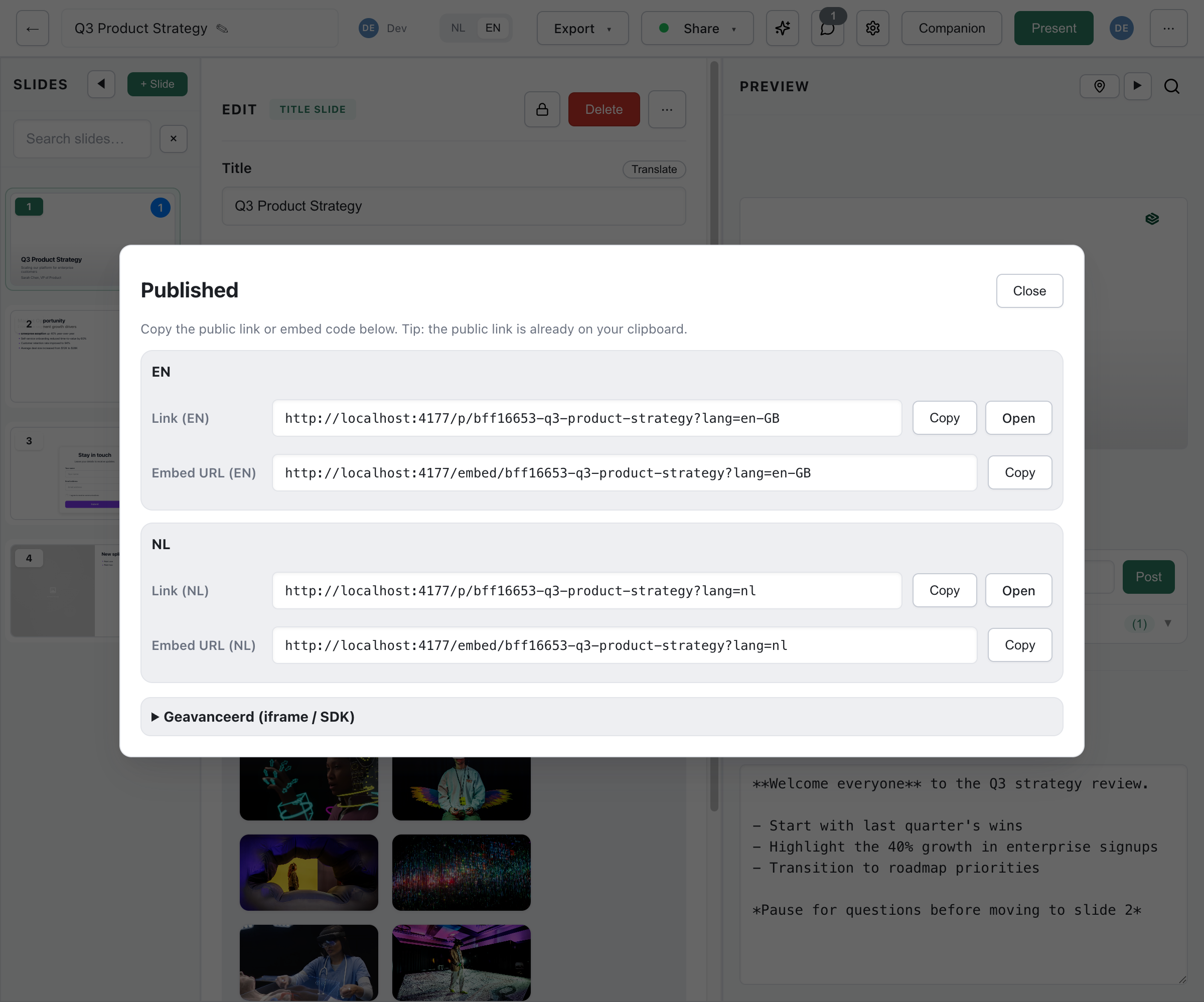
Publishing Options
Section titled “Publishing Options”Public Links
Section titled “Public Links”Generate a public link that anyone can access:
- Open your presentation
- Click Share > Publish
- Get your public link in the format
/p/[id]-[slug]
The slug is auto-generated from your presentation title for SEO-friendly URLs.
Customize the URL slug:
- Publish your presentation
- Click Edit Slug in the share menu
- Enter a custom URL-friendly slug
Private Share Links
Section titled “Private Share Links”Create share links with access controls:
- Password protection - Require a password to view
- Email verification - Require guest email before access
- Expiration dates - Links automatically expire
- View/edit permissions - Control what recipients can do
See Sharing & Permissions for details.
Embedding
Section titled “Embedding”Embed presentations in external websites using the Deckyard SDK:
<div id="presentation"></div><script src="https://your-instance.com/client/embed-sdk.js"></script><script> PresentationSystemEmbed.createDeckEmbed({ el: document.getElementById('presentation'), publishId: '3f9a1c2e', options: { baseUrl: 'https://your-instance.com' } });</script>See Embedding for the options, and the Embed SDK reference for everything the SDK can do.
PDF Export
Section titled “PDF Export”Download your presentation as a static PDF for offline sharing:
- Open your presentation
- Click Export > PDF
- Configure options (slides per page, include notes)
- Download the PDF file
See PDF Export for details.
URL Structure
Section titled “URL Structure”Publish URLs
Section titled “Publish URLs”/p/[publishId]-[slug]Example: /p/ABC123-quarterly-review
publishId- Unique identifier (6 characters)slug- URL-friendly version of title
Embed URLs
Section titled “Embed URLs”/embed/[publishId]-[slug]Used internally by the embed SDK.
Follow URLs
Section titled “Follow URLs”/f/[code]Short codes for audience follow mode. See Follow Mode.
Depublishing
Section titled “Depublishing”To remove a published presentation from public access:
- Open your presentation
- Go to Share
- Click Unpublish
The public URL will immediately stop working. Existing embeds will show an error message.
OpenGraph Previews
Section titled “OpenGraph Previews”When you publish, Deckyard automatically generates OpenGraph preview images for social media sharing. These are created from your first slide and optimized for platforms like Twitter, LinkedIn, and Slack.
See OpenGraph Images for customization options.
Webhooks
Section titled “Webhooks”Trigger external actions when presentations are published:
{ "event": "presentation.published", "pres": { "id": "...", "title": "..." }, "extra": { "publishId": "ABC123", "slug": "quarterly-review", "path": "/p/ABC123-quarterly-review", "ogImageUrl": "..." }}See Webhooks for configuration.
RSS Feeds
Section titled “RSS Feeds”Syndicate your published presentations via RSS, Atom, or JSON Feed. When enabled, feed readers, Slack channels, and automation tools can subscribe to your workspace’s feed and receive updates whenever presentations are published or updated.
Enable RSS feeds in Settings > Integrations. Individual presentations can opt out via the Exclude from RSS feed checkbox in Deck Settings.
See RSS Feeds for setup and configuration.
Best Practices
Section titled “Best Practices”Before Publishing
Section titled “Before Publishing”- Review all slides for accuracy
- Check that speaker notes are appropriate (if exporting with notes)
- Verify translations are complete (if multi-language)
- Test interactive elements
URL Management
Section titled “URL Management”- Use descriptive slugs for SEO
- Keep URLs stable (changing slugs breaks links)
- Track which links are shared where
Security
Section titled “Security”- Use share links for sensitive content (not public URLs)
- Set expiration dates for time-limited access
- Enable password protection for confidential presentations