

Real-time Editing
Edit presentations together with your team in real-time.
Overview
Section titled “Overview”Deckyard supports concurrent editing with automatic slide-level locking to prevent conflicts. Multiple users can work on the same presentation simultaneously while seeing each other’s presence.
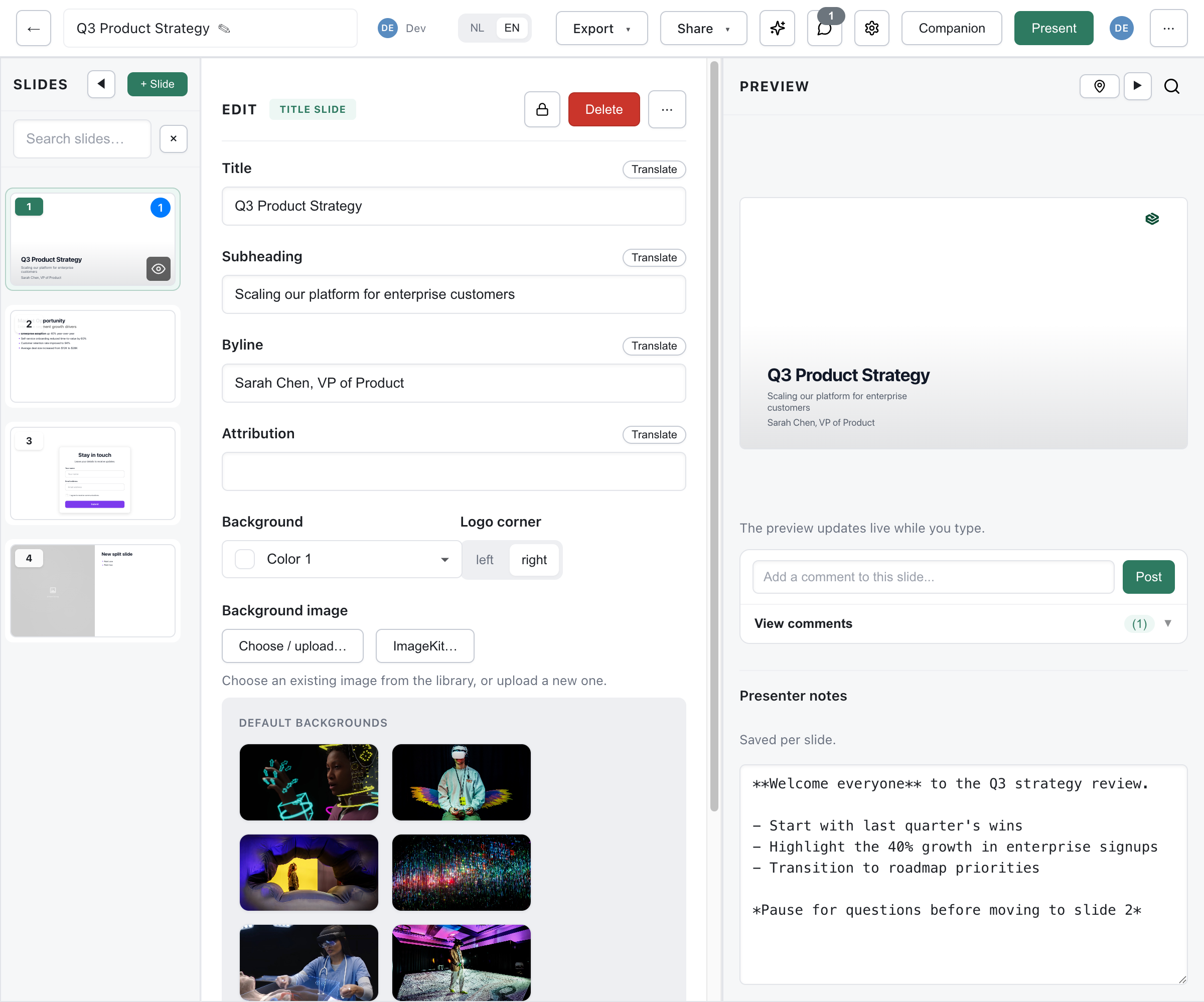
Slide Locks
Section titled “Slide Locks”When you start editing a slide, it becomes locked to prevent others from making conflicting changes.
How Locks Work
Section titled “How Locks Work”- You click on a slide to edit it
- The system automatically acquires a lock for you
- Other users see a lock indicator on that slide
- When you finish editing, the lock is released
Lock Behavior
Section titled “Lock Behavior”- Automatic acquisition - Locks are acquired when you begin editing
- Timeout release - Locks automatically release after 2 minutes of inactivity
- Manual release - You can explicitly release a lock by leaving the slide
- Visual indicator - Locked slides show who is editing
Lock Indicators
Section titled “Lock Indicators”In the slide navigator, you’ll see:
- Green dot - You are editing this slide
- Orange dot - Another user is editing (shows their name)
- No dot - Slide is available
Presence Indicators
Section titled “Presence Indicators”See who else is viewing and editing the presentation in real-time.
Active Collaborators
Section titled “Active Collaborators”The editor shows:
- Avatar row - Profile pictures of active users
- Cursor position - Which slide each user is viewing
- Editing status - Who is actively making changes
User Status
Section titled “User Status”Each collaborator shows their status:
- Viewing - Looking at the presentation
- Editing - Actively making changes
- Idle - Connected but inactive
Presence Updates
Section titled “Presence Updates”Presence information updates in real-time:
- Users appear when they open the presentation
- Position updates as they navigate slides
- Users disappear when they close the presentation
Conflict Resolution
Section titled “Conflict Resolution”Deckyard uses several strategies to prevent and resolve conflicts.
Prevention
Section titled “Prevention”The primary strategy is conflict prevention:
- Slide-level locking prevents simultaneous edits
- Locks are acquired before changes can be made
- Visual indicators warn users about locks
Automatic Merge
Section titled “Automatic Merge”For non-conflicting changes:
- Different slides can be edited simultaneously
- Changes are merged automatically
- All users see updates in real-time
Conflict Scenarios
Section titled “Conflict Scenarios”When conflicts might occur:
Lock Timeout: If your lock times out while editing:
- System attempts to reacquire the lock
- If another user has it, you’re notified
- Your changes are preserved locally
- You can retry when the slide is available
Connection Issues: If your connection drops:
- Unsaved changes are preserved locally
- When reconnected, changes are synced
- If conflicts exist, you’re prompted to resolve
Manual Resolution
Section titled “Manual Resolution”If a conflict can’t be auto-resolved:
- You see a conflict notification
- Both versions are shown
- Choose which version to keep
- Or merge manually
Real-time Updates
Section titled “Real-time Updates”Server-Sent Events (SSE)
Section titled “Server-Sent Events (SSE)”Deckyard uses SSE for real-time communication:
- Low latency updates
- Efficient connection management
- Automatic reconnection
What Updates in Real-time
Section titled “What Updates in Real-time”- Slide content changes
- Slide additions and deletions
- Reordering of slides
- Collaborator presence
- Comments and reactions
- Lock status changes
Update Propagation
Section titled “Update Propagation”When you make a change:
- Change is sent to the server
- Server validates and saves
- Server broadcasts to all connected clients
- Other users see the update
Update Notifications
Section titled “Update Notifications”When another user saves changes to the presentation you’re editing, you’ll see:
- Toast notification — A brief info message appears at the bottom of the screen showing who made the change, e.g. “Slides updated by jane@example.com”
- Automatic merge — The updated slides are merged into your local view without interrupting your work. Slides you have locked are never overwritten.
Rapid successive saves from the same collaborator are coalesced into a single notification so the editor stays uncluttered.
Working with Locks
Section titled “Working with Locks”Requesting a Lock
Section titled “Requesting a Lock”If a slide is locked by someone else:
- You see who has the lock
- You can request they release it
- They receive a notification
- They can choose to release or continue
Force Release (Admin)
Section titled “Force Release (Admin)”Users with admin permission can force-release locks:
- Click on the locked slide
- Click Force Release
- Confirm the action
Use sparingly - the other user may lose work.
Best Practices
Section titled “Best Practices”Communicate:
- Use comments to coordinate
- Let others know when you’re done
Work in sections:
- Divide work by slide sections
- Avoid competing for the same slides
Save frequently:
- Changes auto-save, but be aware of lock timing
- Finish slides before moving on
Connection Status
Section titled “Connection Status”Indicators
Section titled “Indicators”The editor shows your connection status:
- Green - Connected and synced
- Yellow - Reconnecting
- Red - Disconnected
Offline Behavior
Section titled “Offline Behavior”If you lose connection:
- You can continue viewing
- Edits are queued locally
- When reconnected, changes sync
Reconnection
Section titled “Reconnection”Automatic reconnection happens:
- On network recovery
- With exponential backoff
- Your session state is preserved
Performance
Section titled “Performance”Large Presentations
Section titled “Large Presentations”For presentations with many slides:
- Only visible slides load fully
- Thumbnails load on demand
- Lock checks are optimized
Many Collaborators
Section titled “Many Collaborators”With many simultaneous users:
- Presence updates are batched
- Lock notifications are prioritized
- UI updates are throttled