

PowerPoint Export
Export a presentation as a .pptx file that opens in Microsoft PowerPoint and other applications that read the format.
The PowerPoint file is a faithful picture of your deck, not an editable rebuild of it. Each slide is rendered by Deckyard and placed in the file as one full-slide image, so it looks exactly like it does in Deckyard, but its text and shapes cannot be edited in PowerPoint. Keep editing in Deckyard and export again when the content changes.
How to Export
Section titled “How to Export”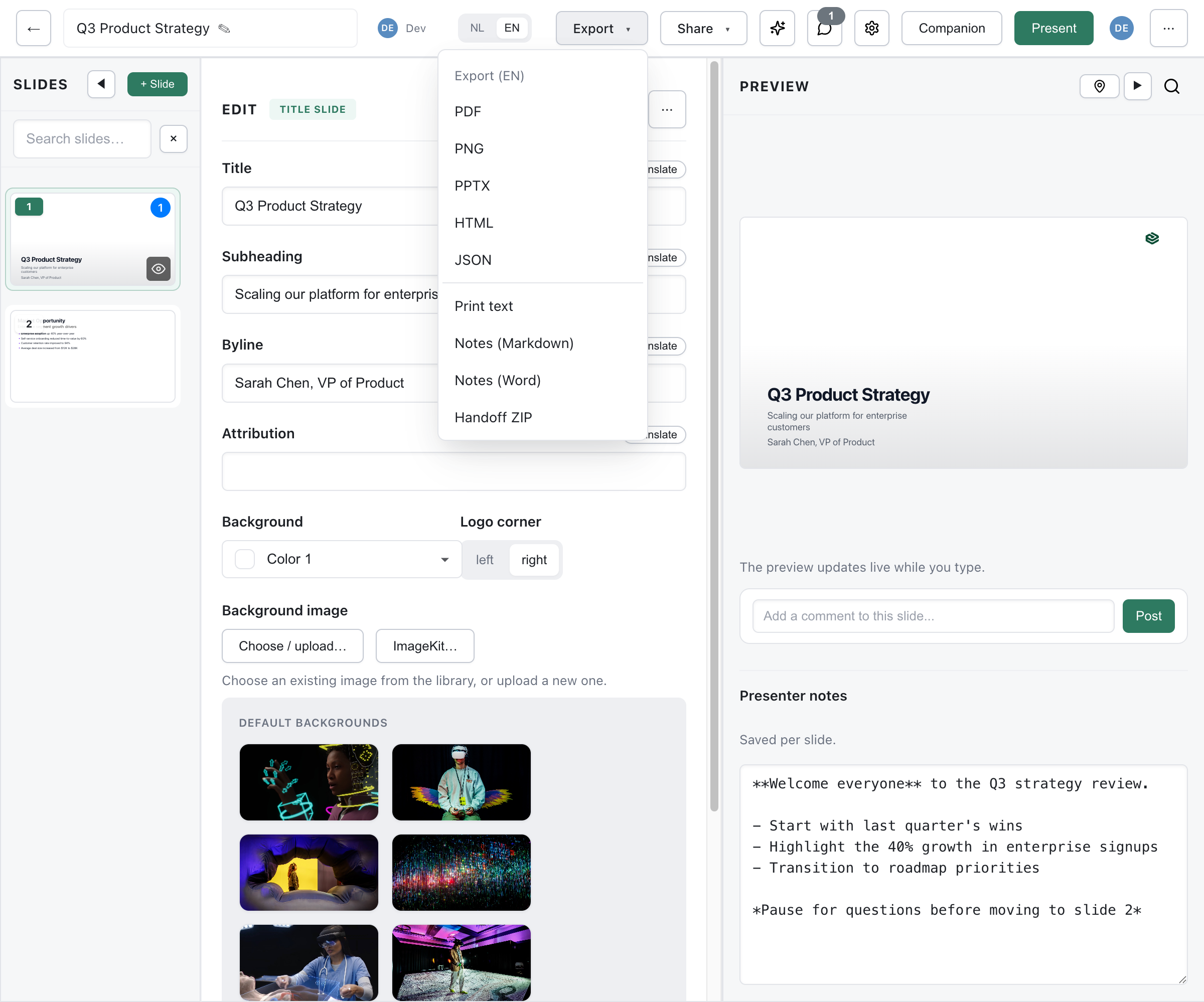
- Open your presentation in the editor
- Click Export in the top bar (it is also available from the Share dialog)
- Choose the language version at the top of the dialog, if the deck has more than one
- Click PPTX under Slides
Deckyard builds the file on the server and hands it to your browser as a download.
What’s in the File
Section titled “What’s in the File”| Part | How it is exported |
|---|---|
| Slides | One PNG image per slide, filling the whole 16:9 slide |
| Text | Part of the slide image; not selectable or editable |
| Fonts | Rendered into the image, so no font substitution on the receiving end |
| Images and charts | Part of the slide image, including images linked from other websites |
| Speaker notes | Added as PowerPoint notes on each slide that has them |
| Video slides | Handled separately, see below |
| Follow-along invite slides | Left out: they only mean something during a live session |
| Animations, polls, Q&A | Not exported |
The slide images are rendered at twice the 1600 × 900 slide canvas (3200 × 1800 pixels). The export API accepts a scale parameter from 1 to 3 if you need a smaller or larger file; the dialog always uses the default.
Video Slides
Section titled “Video Slides”Video slides are the one slide type that is not turned into a picture:
- Bunny Stream videos are downloaded as MP4 (720p) and embedded in the slide, so they play in PowerPoint without an internet connection. This requires the server to have a Bunny pull zone configured (
BUNNY_PULLZONE) and MP4 fallback enabled in Bunny; videos over 200 MB are not embedded. - YouTube and Vimeo videos, and Bunny videos that could not be embedded, become a placeholder slide with the video title, a short explanation and a link to the video. Add the video yourself in PowerPoint if you need it to play.
The placeholder text is currently written in Dutch, whatever the language of the deck.
PPTX Template
Section titled “PPTX Template”The export dialog also offers PPTX template: an empty PowerPoint file with your theme’s backgrounds, fonts, text colours and logo applied to its layouts. It contains no slides from your deck. Use it as a starting point for work that has to happen in PowerPoint; changing a layout in PowerPoint later does not restyle slides that already exist.
When to Use PowerPoint Export
Section titled “When to Use PowerPoint Export”- Presenting from a machine without Deckyard, such as a conference laptop that only runs PowerPoint. Because the slides are images, they look the same everywhere and need no fonts or network.
- Handing a deck to someone who works in PowerPoint, as a reference or to present from.
- Archiving a version in a widely readable format.
If the recipient needs to change the content, give them access to the deck in Deckyard instead, or export JSON or a .deck bundle for a technical handover. For a copy that keeps the deck’s own navigation, use the HTML export.
Troubleshooting
Section titled “Troubleshooting”Text Cannot Be Edited
Section titled “Text Cannot Be Edited”This is expected: every slide except video slides is an image. Edit the deck in Deckyard and export again.
Large File Size
Section titled “Large File Size”Every slide is a high-resolution image, and embedded Bunny videos add their full size. To reduce the file:
- Remove slides you do not need before exporting
- Use a lower
scalethrough the export API - Link to the video instead of embedding it
A Video Slide Shows a Placeholder
Section titled “A Video Slide Shows a Placeholder”YouTube and Vimeo videos are never embedded. For a Bunny video, the placeholder names the reason, for example a missing pull zone on the server or a download that failed. Ask your administrator to check the Bunny settings, or add the video in PowerPoint yourself.