

Instance Settings
Configure global settings for your Deckyard instance.
Overview
Section titled “Overview”Instance settings control behavior across your entire Deckyard installation. Settings are divided into:
- App settings - Global configuration accessible to admins
- User settings - Per-user preferences like display name and language
Settings Panel
Section titled “Settings Panel”Access the settings panel from the admin menu. Here you can configure:
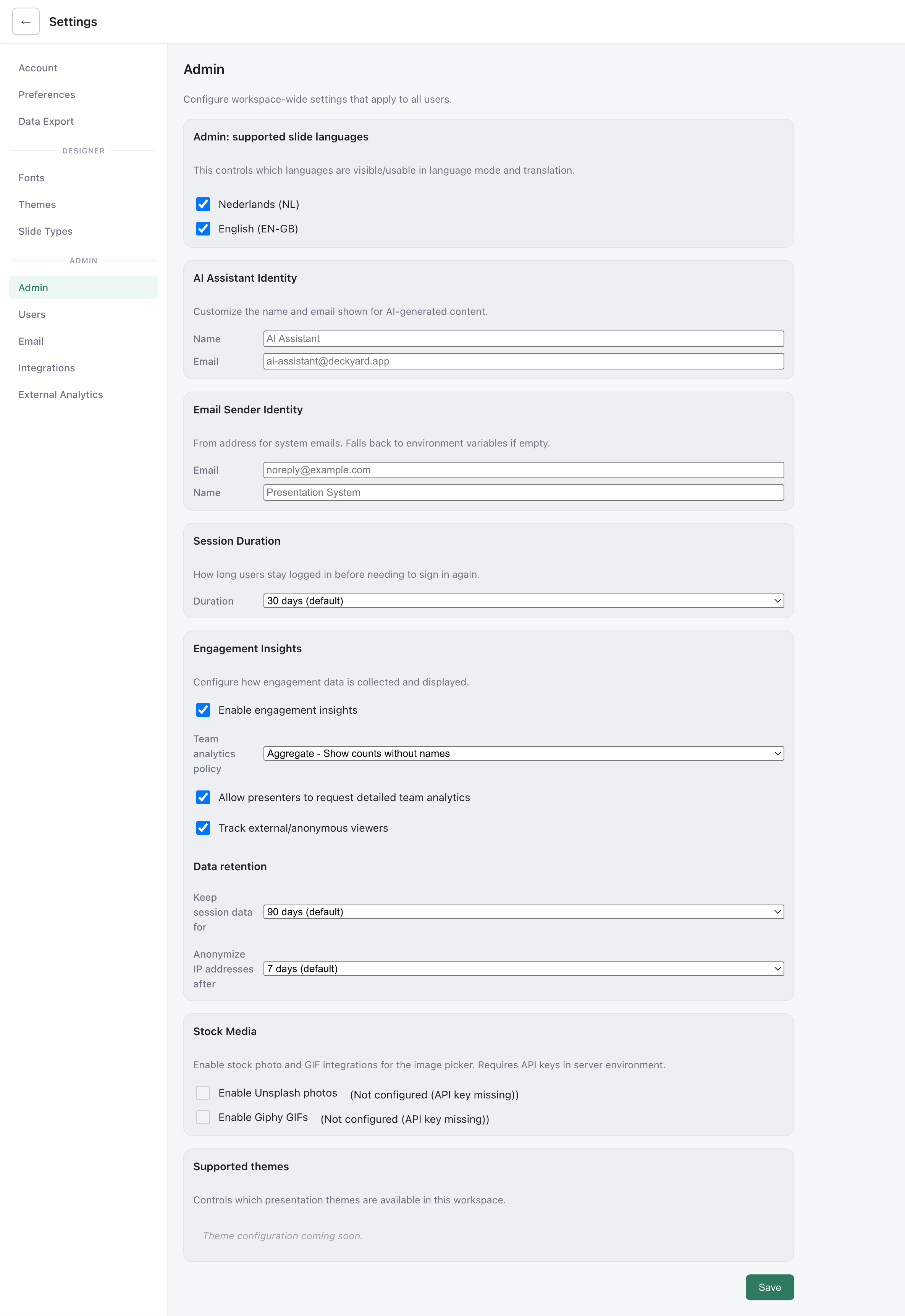
General Settings
Section titled “General Settings”- Organization name - Your organization’s display name
- Default language - Language for new users
- Default theme - Theme applied to new presentations
Email Sender Identity
Section titled “Email Sender Identity”Configure the sender information for outgoing emails:
{ "email": "presentations@yourcompany.com", "name": "Your Company Presentations"}This overrides the default sender configured via BREVO_SENDER_EMAIL and BREVO_SENDER_NAME environment variables.
Supported Languages
Section titled “Supported Languages”Define which languages are available for presentation content:
{ "supportedLanguages": ["en-GB", "nl", "de", "fr"]}Users can create multi-language content only in these configured languages.
Webhook Configuration
Section titled “Webhook Configuration”Configure webhooks to integrate with external services. Webhooks send HTTP POST requests when specific events occur.
Available Webhook Events
Section titled “Available Webhook Events”| Event | Description |
|---|---|
presentation.published | A presentation was published |
presentation.moved_to_organization | A presentation was moved to the organization |
slide.added_to_organization_library | A slide was added to the organization library |
comment.created | A comment was added to a presentation |
interaction.poll_closed | A poll was closed |
interaction.feedback_submitted | Feedback was submitted |
interaction.likert_closed | A Likert survey was closed |
Configuring Webhooks
Section titled “Configuring Webhooks”In the settings panel, enter the URL for each webhook you want to enable:
{ "webhooks": { "presentationPublishedUrl": "https://your-service.com/webhook/published", "interactionPollClosedUrl": "https://your-service.com/webhook/poll", "commentCreatedUrl": "https://your-service.com/webhook/comment" }}Webhook Payload
Section titled “Webhook Payload”Webhooks receive a JSON payload with event details:
{ "event": "presentation.published", "createdAt": "2025-01-15T10:30:00.000Z", "actor": { "id": "user@example.com", "email": "user@example.com", "name": "John Doe", "role": "user" }, "presentation": { "id": "abc123", "title": "Quarterly Review", "description": "Q4 2024 results", "theme": "corporate", "scope": "private", "published": { "id": "xyz789", "slug": "quarterly-review", "path": "/p/xyz789-quarterly-review", "url": "https://your-instance.com/p/xyz789-quarterly-review" } }, "links": { "editPath": "/app/abc123", "editUrl": "https://your-instance.com/app/abc123", "publicPath": "/p/xyz789-quarterly-review", "publicUrl": "https://your-instance.com/p/xyz789-quarterly-review" }}Webhook Headers
Section titled “Webhook Headers”Each webhook request includes:
Content-Type: application/json; charset=utf-8User-Agent: presentation-system-webhook/1X-SB-Event: [event-name]
Webhook Behavior
Section titled “Webhook Behavior”- Webhooks are sent asynchronously and don’t block the API response
- Failed webhooks are logged but not retried
- Webhook timeout is 4.5 seconds
Feature Toggles
Section titled “Feature Toggles”Enable or disable specific features via environment variables.
Available Toggles
Section titled “Available Toggles”| Variable | Default | Description |
|---|---|---|
DEMO_MODE | false | Enable demo mode (restricted features) |
SANDBOX_MODE | false | Enable sandbox mode for public demos |
UPLOADS_ENABLED | true | false disables direct file uploads |
IMAGE_LIBRARY_ENABLED | true | false disables the local image library |
IMAGEKIT_ONLY | false | Only use ImageKit for images |
NOTION_FEATURE | false | true enables the Notion subjects, compose and suggestion endpoints |
The older spellings DISABLE_UPLOADS and DISABLE_IMAGE_LIBRARY still work with a boot warning until the first release after 1 November 2026. The full list is in Environment Variables.
Demo Mode
Section titled “Demo Mode”When DEMO_MODE=true:
- Some admin features are restricted
- Data modifications may be limited
- Useful for public product demonstrations
Feature Detection
Section titled “Feature Detection”The client automatically detects available features based on:
- Environment configuration
- API key availability (AI features, media services)
- Database mode
API Access
Section titled “API Access”Settings are available via the API:
Get App Settings
Section titled “Get App Settings”GET /api/settings/appReturns global settings (webhooks excluded for non-admins).
Update App Settings (Admin only)
Section titled “Update App Settings (Admin only)”PUT /api/settings/appContent-Type: application/json
{ "supportedLanguages": ["en-GB", "nl"]}Get User Settings
Section titled “Get User Settings”GET /api/settings/meUpdate User Settings
Section titled “Update User Settings”PUT /api/settings/meContent-Type: application/json
{ "profile": { "name": "John Doe" }, "language": "nl"}